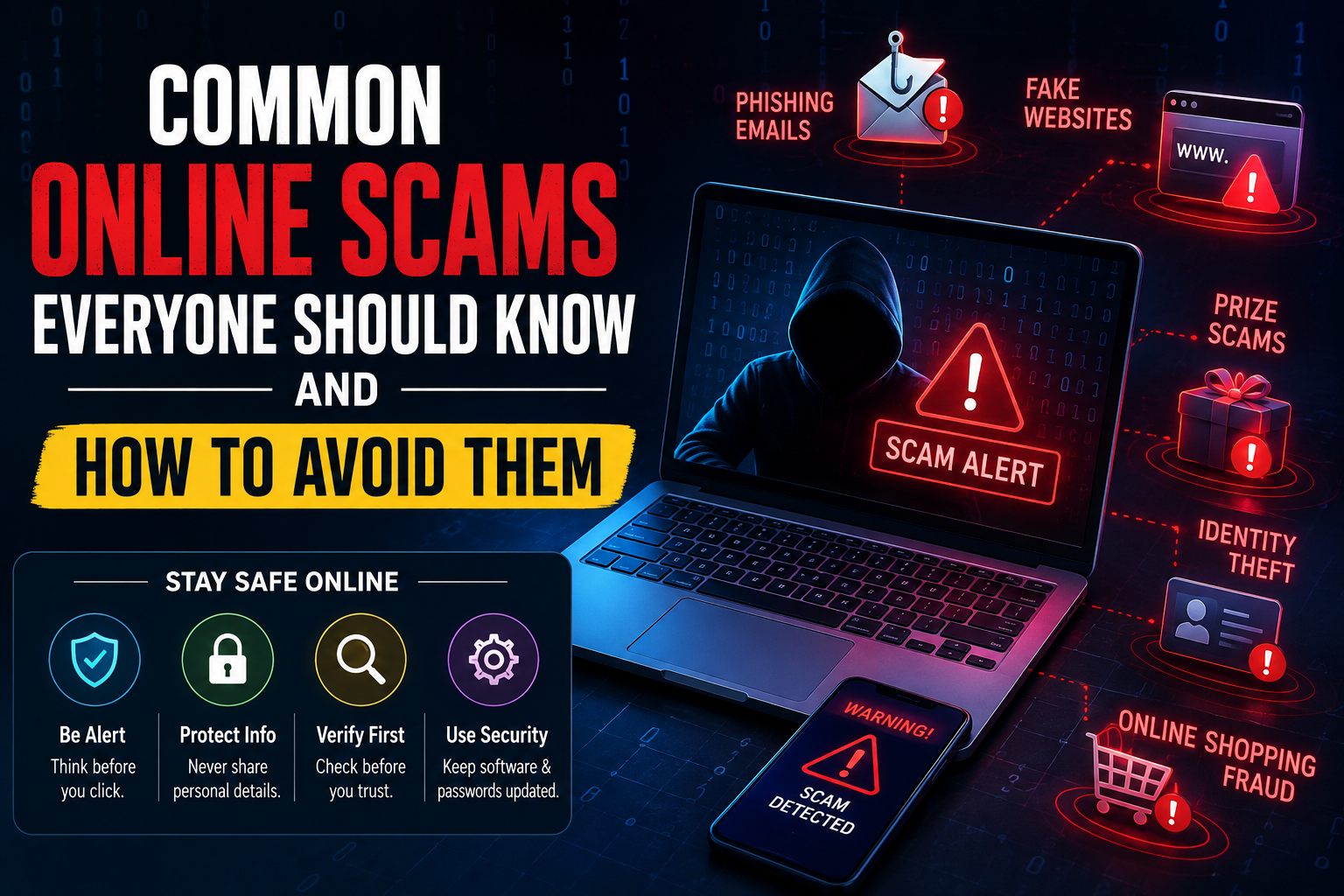
Scams can look surprisingly convincing. Learn the warning signs, understand the most common schemes, and build simple habits that can help protect your money, accounts, and personal information.
The internet has made it easier to shop, communicate, manage money, apply for jobs, pay bills, and handle everyday tasks. Unfortunately, it has also given scammers more ways to reach people. A fraudulent message can arrive by email, text, phone call, social media, an online advertisement, or even a fake website that looks almost identical to a legitimate one.
Online scams are not always obvious. Some scammers use professional-looking logos, familiar company names, fake customer-service representatives, convincing websites, and urgent messages to make their stories seem legitimate. According to the Federal Trade Commission, consumers reported more than $12.5 billion in fraud losses in 2024, while reported losses to imposter scams reached $2.95 billion. :contentReference[oaicite:0]{index=0}
In 2025, people reported losing $3.5 billion to imposter scams, making impersonation the most frequently reported fraud category to the FTC. :contentReference[oaicite:1]{index=1}
The good news is that many scams share the same warning signs. Learning how these schemes work can help you slow down, verify unexpected requests, and avoid making decisions under pressure.
Stop. Slow Down. Verify.
Unexpected messages that create fear, urgency, or excitement deserve extra attention. Do not let a stranger’s deadline decide what you do with your money or personal information.
1. Phishing Emails and Text Messages
Phishing is one of the most common online scams. A scammer sends an email or text that appears to come from a bank, credit card company, delivery service, utility provider, online store, or another organization you recognize.
The message may claim that your account has a problem, a payment failed, a package cannot be delivered, or suspicious activity was detected. You are then encouraged to click a link, open an attachment, or provide information.
The Federal Trade Commission warns that phishing messages are designed to steal information such as passwords, account numbers, or Social Security numbers. :contentReference[oaicite:2]{index=2}
A message wants you to click immediately.
It claims your account will be closed or suspended.
It asks for passwords, banking details, or personal information.
If you think a message could be legitimate, do not use the link or phone number inside it. Instead, visit the organization’s official website yourself or use a phone number you already know is genuine.
2. Fake Bank and Financial Institution Scams
Financial scams can be particularly stressful because they often begin with a frightening message about your money. A caller or text may claim that someone accessed your bank account or that a transaction needs to be stopped immediately.
The scammer may then tell you to move your money into a supposedly “safe” account. This is a major warning sign. The FTC specifically warns that legitimate officials will not tell you to transfer money to protect it. :contentReference[oaicite:3]{index=3}
If you receive an unexpected financial warning, stop the conversation. Log in through your normal banking app or website, or call the number printed on your bank card or statement.
3. Government Impersonation Scams
Scammers may pretend to represent a government agency, law enforcement department, court, or other official organization.
The caller may claim that you owe money, missed jury duty, have a legal problem, or need to verify your identity. Some scammers threaten arrest or other consequences unless you pay immediately.
Government impersonation scams can look very official. A caller may provide a fake badge number, employee ID, or agency name. The FTC advises consumers not to send money or cryptocurrency in response to unexpected government-related demands and to independently verify any claim. :contentReference[oaicite:4]{index=4}
Pressure Is a Warning Sign
A legitimate organization may ask you to resolve a real issue, but an unexpected stranger demanding immediate payment through an unusual method should make you stop and verify the situation independently.
4. Online Shopping Scams
Online shopping scams can appear on websites, social media, search results, and advertisements. A product may be advertised at an unusually low price, sometimes using the name or appearance of a recognizable brand.
After clicking the advertisement, you might be sent to an unfamiliar website that collects payment information but never delivers the product. Other scams may send counterfeit products, poor-quality items, or something completely different from what was advertised.
The FTC recommends researching the seller and website before buying and searching for reviews or complaints. When possible, paying by credit card can provide additional dispute protections if something goes wrong. :contentReference[oaicite:5]{index=5}
5. Fake Job and Employment Scams
Job scams can be especially convincing because they often target people who are actively looking for work. A fake recruiter may contact you through email, text, social media, or a job platform and offer an attractive position.
The scam may eventually require you to pay for training, equipment, certifications, starter kits, or other supposed employment costs. Some scammers may also send fake checks and ask you to purchase items or send money elsewhere.
Be cautious when a job offer arrives unexpectedly, promises unusually high earnings for very little work, or requires payment before employment begins. Research the company independently and verify the position through its legitimate website.
6. Tech Support Scams
Tech support scams usually begin with a frightening warning. You might see a pop-up claiming that your computer has a serious virus or receive an unexpected call from someone claiming to be technical support.
The scammer may ask you to install remote-access software, provide passwords, or pay for unnecessary repairs.
Do not give an unexpected caller remote access to your computer. If you are genuinely concerned about a device problem, contact the manufacturer or a trusted technician through information you find independently.
7. Package Delivery Scams
Fake package messages are effective because many Americans regularly order products online. A text might claim that your package is delayed and that you need to pay a small fee or confirm your address.
The link can lead to a fake website designed to collect personal or payment information.
If you are expecting a delivery, check its status through the retailer’s official website or the carrier’s legitimate website or app. Avoid using links in unexpected delivery messages.
8. Romance and Relationship Scams
Romance scams often begin on dating websites or social media. A scammer creates a fake identity, builds an emotional relationship, and eventually invents a reason they need money.
The request may involve an emergency, travel problem, medical expense, investment opportunity, or another convincing story.
Emotional trust does not prove someone’s identity. Be especially careful if someone you have never met in person asks you to send money, purchase gift cards, transfer cryptocurrency, or share sensitive financial information.
Romance scams also remain a significant problem on social media. FTC data show that nearly 60% of people who reported losing money to a romance scam in 2025 said the scam began on a social media platform. :contentReference[oaicite:6]{index=6}
9. Investment and Cryptocurrency Scams
Investment scams often promise unusually high returns with little or no risk. You may see advertisements for an exclusive opportunity, receive investment advice from someone online, or be shown a website displaying fake profits.
Scammers may pressure you to invest quickly because they claim the opportunity will disappear soon.
Never assume an investment is legitimate simply because someone shows you screenshots of successful trades or impressive account balances. Research the investment independently and be skeptical of guaranteed returns.
The FTC reported that consumers lost $5.7 billion to investment scams in 2024, more than any other fraud category by reported dollar losses that year. :contentReference[oaicite:7]{index=7}
Investment Red Flags
• Guaranteed or unusually high returns
• Pressure to invest immediately
• Requests to send cryptocurrency to an unfamiliar wallet
• A platform that shows profits but makes withdrawals difficult
• Advice from an online stranger who suddenly introduces an investment opportunity
10. Fake Prize and Giveaway Scams
Winning something feels exciting, which is exactly why prize scams can work so well. A message may say that you won money, a car, a vacation, or another valuable prize.
The catch is usually that you need to pay a fee, provide banking information, buy gift cards, or send cryptocurrency before receiving the prize.
Be skeptical of unexpected prizes. If you never entered a legitimate contest, there is a strong reason to question the claim. A demand for payment before receiving a supposed prize is another major warning sign.
11. Family Emergency and “Someone You Know” Scams
A scammer may contact you pretending to be a relative, friend, coworker, or even your boss. They might claim they are in an emergency and need money immediately.
Modern technology can make these scams more convincing because scammers may use information from social media or other public sources. Voice-cloning technology can also make a fraudulent call sound more familiar.
If someone unexpectedly asks for urgent financial help, verify their identity through a separate communication method. Call the person using a number you already have rather than continuing the suspicious conversation.
12. Social Media Scams
Social media platforms give scammers access to huge audiences. Fraud can appear through fake advertisements, hacked accounts, fraudulent investment offers, fake stores, romance schemes, or messages from impersonated friends.
FTC data show that nearly 30% of people who reported losing money to scams in 2025 said the scam started on social media, with reported losses reaching $2.1 billion. :contentReference[oaicite:8]{index=8}
Be careful with advertisements offering extreme discounts, investment opportunities, unexpected prizes, and messages asking you to move conversations to another platform.
13. Gift Card Payment Scams
Scammers often ask victims to purchase gift cards and provide the card numbers or codes. Once the information is shared, the money can be difficult to recover.
A stranger who insists that you pay a government fine, utility bill, debt, prize fee, or emergency expense using gift cards is displaying a major scam warning sign.
Legitimate businesses and government agencies do not normally demand payment through gift cards for these purposes.
14. Fake Refund and Account Alert Scams
Another common strategy is to tell you that a refund is waiting for you or that an account has been charged incorrectly.
The scammer may say they can help you recover the money, but the real objective is to obtain your login details, payment information, or remote access to your device.
Do not click unexpected refund links. If you think a refund or account issue may be real, open the company’s official app or website yourself and check your account there.
15. Fake Websites and Search Results
Not every scam begins with an email. Fraudulent websites can appear through advertisements, social media, or search results.
A fake website may use familiar colors, logos, product photos, or business names to appear legitimate. Always check the website address carefully and avoid assuming that a professional design means a site is trustworthy.
When accessing a bank, government service, retailer, or other important account, it is safer to navigate to the official website yourself rather than relying on an unexpected link.
How to Protect Yourself From Most Online Scams
1. Slow down. Urgency is one of the scammer’s favorite tools.
2. Verify independently. Use an official website, app, statement, or trusted phone number.
3. Protect your accounts. Use strong, unique passwords and two-factor authentication where available.
4. Avoid unexpected links. Type the website address yourself when possible.
5. Never share security codes. Treat one-time verification codes as private information.
6. Be cautious with unusual payments. Gift cards, cryptocurrency, cash, and wire transfers can be difficult to recover.
7. Ask someone you trust. A second opinion can help when a message feels urgent or confusing.
What to Do If You Think You Have Been Scammed
If you realize that you sent money or shared personal information with a scammer, act quickly. Contact the bank, credit card company, payment provider, or other organization involved and explain what happened.
If you shared a password, change it immediately, especially if you reused that password elsewhere. Enable two-factor authentication where available.
If you gave someone remote access to your computer, disconnect the device from the internet and consider getting help from a trusted technology professional. Review your accounts for unusual activity.
You can also report scams to the Federal Trade Commission through its official fraud-reporting service. Reporting may help authorities identify patterns and protect other consumers. :contentReference[oaicite:9]{index=9}
Do Not Let Someone Else’s Urgency Become Your Emergency
If an unexpected message says you must act immediately, pay immediately, click immediately, or keep the situation secret, pause. Verify the claim through a trusted source before doing anything.
Frequently Asked Questions
Awareness Is One of Your Best Defenses
Online scams continue to change, but the basic tactics are often familiar: create urgency, impersonate someone trustworthy, promise something valuable, or frighten you into acting before you have time to think.
You do not need to recognize every new scam to protect yourself. Build a few reliable habits instead. Slow down when a message feels urgent, verify unexpected claims independently, protect your passwords and accounts, and never let a stranger pressure you into sending money or sensitive information. Those simple habits can make a meaningful difference in protecting your digital and financial life.